Did You Question the Machine?
There are two people I talk to almost every week, and they are using the same tool to do the same job, and they are not doing the same thing at all.
The first one ships fast. The model proposes, and the answer is yes. Yes, go on. Yes, looks good. Yes, continue. There is a rhythm to it, a soft percussion of acceptance, ok, ok, go on, make it work, and code appears, and the code mostly runs, and at six in the evening there is a feature that was not there at nine in the morning. Call it token-maxxing. Feed the machine, take the output, move on. The output is real. The feature is real. Nobody is lying about having done work.
The second one is slower, and looks, from across the room, less productive. This person argues with the model. Builds harnesses around it. Writes tests the model has to pass before its code is allowed to live. Has constructed, over months, a private memory system so the model produces code that follows the standards this person would have followed by hand, code that someone will still be able to maintain in three years. Every action the model takes is inspected, approved surgically, sent back when it is wrong. Call it thinking-maxxing. Same tool. Same blinking cursor. Opposite act.
From across the room, in the demo, can you tell them apart? Both produce something. Both ship. The difference does not live in the output. It lives in a place the demo never shows you.
Hold that, because I want to start somewhere that sounds unrelated.
What does a good company actually do when it delegates?
A good company delegates. It is close to the definition of a functioning organization. You hand off the work that someone else can do so you can spend yourself on the work only you can do. The senior gives the junior the boring ticket. The manager gives the report to the analyst. Delegation is how an organization scales past the size of one heroic person’s calendar. We teach it, we promote for it, we diagnose its absence as a flaw. He can’t delegate is something you say about a person who is failing.
So delegation is a virtue. Who has ever stood up in a room and argued the opposite?
But look closely at what delegation does inside a healthy company, because there is a second thing happening that we rarely name. When the senior hands the junior the boring work, is the boring work only being offloaded? Or is it tuition? The junior does the rote reps, the unglamorous debugging, the schema migration nobody wanted, and somewhere in the thousandth rep the junior stops being a junior. Were the reps the curriculum all along? Was the delegation an apprenticeship wearing the costume of a favor? Then a good company delegates downward not only to free the senior, but because the act is the machine that manufactures the next one. The capacity would not disappear. It would move. It would land in a person, and compound there.
Where does the muscle go?
Now delegate the same work to the model.
The work gets done. The feature ships. But where did the muscle go this time? The model does not get promoted. It does not become senior. It will not, in three years, be the person who can look at a hard problem and know in their gut where the bug lives, because it never spent the decade that earns that gut. So the capacity did not move to a junior who will carry it forward. Where did it go? Delegating to a person grows a muscle, just not in you. Delegating to the model grows a muscle where, exactly?
And here is where the comfortable story comes apart.
Did you sort them by experience?
I described two people at the start. Did you sort them by experience? The senior thinks, the beginner presses ok. Clean, flattering, and not what I see. The axis of experience and the axis of behavior come apart, and the place where they separate is the most uncomfortable corner of this whole thing: the senior who token-maxxes.
The beginner pressing ok, ok, go on never had the muscle. They are failing to accumulate something they never started. The senior pressing the same key is doing what, by comparison? They built the muscle, over years, through exactly the reps they are now refusing to do, and they are liquidating it. Spending down the capital. And because they still have the residue of the old judgment, they are good at it for a while, good enough that the decline is invisible, good enough that the spending feels like productivity. The beginner never opens the account. The senior empties one they spent ten years filling. Which of them would call the withdrawals income?
There is a name for what this does at scale. The sociologist Robert Merton called it the Matthew effect, after a line in the Gospel: “For unto every one that hath shall be given, and he shall have abundance: but from him that hath not shall be taken away even that which he hath.” The one who can already think uses the model to think harder, to climb a floor, to spend the freed hours on problems that were previously out of reach. The one who cannot think yet uses the model to never have to begin. Does the tool close the gap between them, the way we keep promising it will? Or does it pry the gap open? And the line we repeat about all this, the one about how AI democratizes coding, lowers the barrier, lets anyone build, who is it told most warmly to? Same tool. Three fates. Climb, stall, spend.
Can you feel which one you are?
The cruelty of it is the symmetry. The token-maxxer and the thinking-maxxer have the same calendar, the same shipped features, the same satisfied exhale at six in the evening. The bill is not presented at six in the evening. It is presented later, alone, the first time the thing breaks in a way the model cannot fix, and you sit there and find out whether you can still reason about the code with your name on it. If that is the only audit that matters, and it arrives years after the habit that decides its result, how would you know today which way it will go?
What did the Greeks lower onto the stage?
The Greeks had a word for what happens when you press ok.
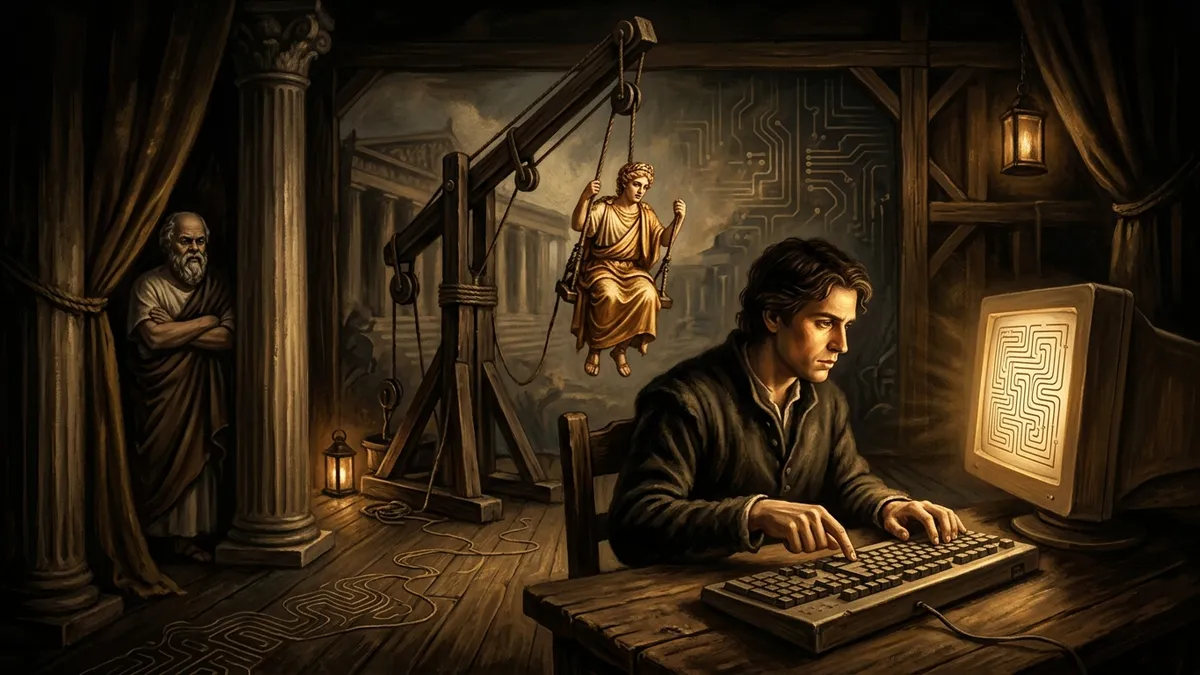
In the theatre of Athens, when a playwright tied the plot into a knot too tight to untie, a god would descend. Lowered onto the stage by a crane, arriving from above to set right what the human characters could not. The crane had a name. The mechane. The machine. Deus ex machina, the god from the machine, is literally the god the machine lowers in. The phrase we reach for to mean a cheap ending is, to the word, the oldest possible description of the newest possible habit, and the machine in it was always a real machine.
Aristotle hated it. The resolution of a plot, he said, must arise from the plot itself, from the characters and their choices, never from a contrivance lowered in from outside. A play that ends because a god descended is a play whose protagonist solved nothing. The audience is cheated, not because the ending is unhappy, but because it was unearned. Nobody grew. Nothing was learned. The knot was not untied. It was cut, by a hand that came from offstage.
So when you hit the problem you cannot solve, and you summon the answer from the machine, and the god descends and fixes the scene and the play moves on, ask the thing Aristotle would ask. Did the protagonist resolve this? Or did you lower in a god to end a scene you could not write? And whose play is it, if the only one who ever resolves anything arrives by crane?
The last time the model proposed and you accepted, did you question the machine before you pressed ok? Not glance at it. Question it. Did you know why the answer was right, well enough that you could have reached it yourself, slower, alone? Or did you press the key the way that company started trusting the spreadsheet, a little at a time, each acceptance too small to object to, until one day the thing was running everything and no one remembered deciding to let it?
Who teaches the junior?
There is a larger chair sitting empty in this room.
The newspapers have started asking, in their nervous way, whether AI will replace the junior developer. Is that the question, though, or the one that hides underneath it? Suppose it does replace them. Suppose the boring tickets, the rote reps, the tuition, all of it goes to the model now, because the model is cheaper and faster and never asks for a raise. Then who teaches the junior? Where, exactly, is the senior of 2031 being made? The apprenticeship engine ran on giving the unglamorous work to the people who needed it to grow. Hand that work to a thing that cannot grow, and have you replaced a junior, or unplugged the machine that makes seniors? And if it is the second, how long before anyone notices a factory that stopped producing the only people who could have judged its replacement?
But what if the machine is the teacher?
Unless.
Here is the possibility I cannot put down, and I think it might be the most hopeful thing in the whole picture. What if the machine is the teacher?
The apprenticeship engine ran on a senior delegating downward. But was the thing the junior actually needed ever the senior? Or was it the reps, and a master patient enough to correct them? And has there ever, in the history of the craft, been a master as patient as this one? Awake at two in the morning. Never bored by the basic question. Willing to explain the same thing nine different ways and never once sigh. The beginner who never wrote a line of code, the one who in the comfortable story was the casualty, could become the first apprentice in history whose master is the tool itself.
Could. On one condition, and it is the same condition this whole piece keeps circling back to. The apprentice has to question the master. The junior who argues with the model, who asks why, who sends the answer back, who reads the output and refuses the suggestion that smells wrong, is that junior not being taught, and taught well, by the best tutor that has ever existed? The junior who presses ok, at the same desk, in the same hour, by the same tutor, is being taught what?
So the machine is the worst thing that ever happened to the next engineer, and the best, and which one it turns out to be is settled by a single small act repeated ten thousand times. The same act we have been circling since the first window blinked. Do you question it? Or do you press ok?
When did delegation start eating the delegator?
You did the most natural thing in professional life. You delegated. You were taught to. You were promoted for it. Delegation was the virtue, remember, the mark of a functioning organization. So when did the virtue turn? When did delegation stop building the next person and start eating the one doing the delegating? At which ok did the most rewarded instinct of your whole career quietly become the thing hollowing you out?
I cannot tell you. And I am not sure you can tell yourself, because the faculty you would use to check whether your thinking still works is the same faculty you are wondering about. Can you audit the muscle with the muscle? Can you use the judgment you may have stopped exercising to determine whether you have stopped exercising it?
So here is the only version of the question that lets neither of us off the hook.
This worry you are feeling right now, this small unease about whether you still think or only approve. Did you arrive at it yourself?
Or did you wait for someone to finish the thought for you?