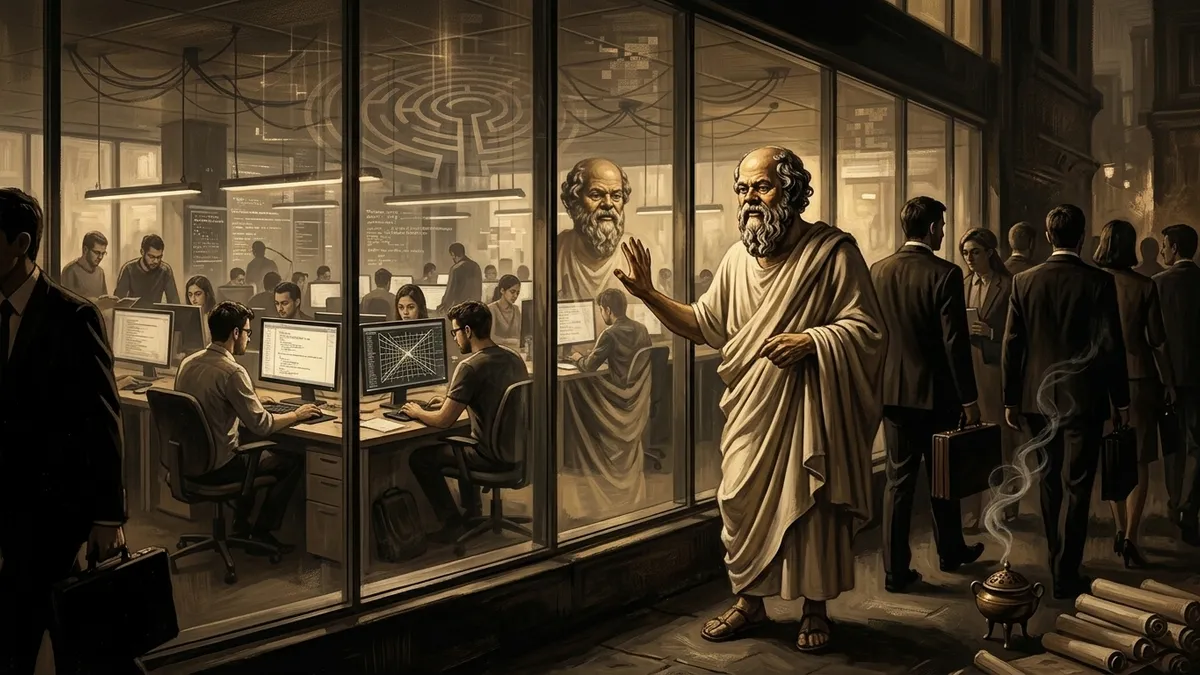
Focus on What, Exactly?
Before it meant anything you could put on a performance review, focus was a fireplace.
That is the literal Latin. Focus, the hearth, the fire at the center of the Roman house, the warm point the whole household gathered around. It was where you cooked, where you kept the gods of the home, where the family came together when the day was done. The word did not mean concentration. It meant the opposite of alone. It meant the place everyone came to.
It stayed a fireplace for fifteen centuries. Then, in 1604, Kepler needed a name for the point where a lens bends all the light to a single spot, the spot so hot it can set paper alight, and he reached for the old word for the burning center of the home. Focus. The place where the rays converge and catch fire.
So the whole life of this word, from the Roman kitchen to the astronomer’s lens, is about one thing: convergence. Things coming together until they ignite. Gathering, not shutting out.
Now listen to how you used it this week. “I need to focus.” Meaning: close the door, kill the notifications, let no one in. We took the word for the fire the whole household gathers around and made it the name for the room nobody is allowed to enter. When did the hearth become a wall?
The rule on the door
You have probably seen the wall version. There is a door, and someone has taped a rule to it, written by hand, because management never writes this rule for you. If the door is closed, do not knock. One exception: someone is dying, right now, and you are the only person on this floor who can save them. Short of that, the closed door means whatever you came to ask can wait, and whatever is happening behind it cannot. Open door, you are welcome. Come in, interrupt, ask anything.
Nobody upstairs makes anyone take that rule down. Why would they? The people who tape rules to doors are not interesting to look at. Hold that word. It comes back.
The aquarium
Somewhere past that door, in almost every building like it, there is a brighter room with glass on the long side. I have stood next to one. We called it the aquarium.
The glass faced the corridor, and the corridor led to exactly one place, the founder’s office. So every visitor walking in to see him passed the developers first, heads down, mid-thought, framed in glass like an exhibit. Customers saw it. Investors saw it. Nobody had to say the line out loud. Look at them. Look how much work is happening in there. Look at all that focus.
Look again at the shape of that room. Everybody gathered into one open space, all of them visible at once, arranged around a center. What is that, if not a hearth? It has the exact shape of one. So where did the fire go? Strip out the warmth and what is left is a household assembled not to come together but to be counted through glass, a hearth with the flame swapped for a sightline. Is that focus, or is it the hearth turned inside out?
There was a second tank, bigger, more of a pool than an aquarium. Who would you build a room like that for? It went up for customer care, the one team in the building that lives on the phone all day, the one team whose work dies in ambient noise, the one team that would trade almost anything for a wall. Then the chairs got rearranged. Customer care was moved out of the pool into a separate room, a double office packed well past comfortable, and the bright open pool went to marketing.
Read that allocation again and ask what it was solving for. The team that most needed quiet got the crowded box. The team whose job is partly performance got the stage. If the rooms had been handed out by the work done inside them, would they have landed that way? Or were they handed out by how each one looked from the corridor?
And there was one rule that could override the closed door. When certain investors came through, the doors had to be open. Not the glass, the glass was always there. The doors. When the important eyes arrived, even glass was not enough. What do you call a tank where the tank itself gets removed for the right audience?
A company, read through its rooms
Watch any company tell its whole life story through the rooms it puts people in. Is a single chapter of it about focus?
It is born in an open space, because there are four of them and no money and it does not matter. It grows, and the people who built it earn doors, real ones that close. Then it gets ambitious and moves somewhere with a lobby and glass, and the glass faces the corridor, and the developers become the exhibit. Then something goes wrong, the way it always eventually does, and the company contracts back into one not-very-big room with four desks in a corner, and by then the open plan is not a strategy at all. It is a tombstone. Seven years can fit in that arc, and the rooms mark every stage of it like rings in a trunk, and at no point did the layout track how well anyone was thinking. What did it track instead? The money. The fear. How much there was to show off. When did it ever track the work?
The cat in the box
Now the question hiding under all of it. Can focus be seen at all? Not by the boss, not by the manager, not even by the person doing it.
You cannot watch your own concentration directly. You only ever notice it afterward, by the trail it left, or you notice it breaking. And you certainly cannot see someone else’s from across a room. A bowed head can be deep work or it can be despair. A still face can be a problem dissolving or a person quietly dying inside. The state you are trying to observe does not have a surface.
It is Schrödinger’s cat, except the box is somebody’s skull. The focus is in there in some unresolved state, and you want to know if it is alive. But the only way to check is to look, and looking is the interruption, and the interruption collapses the thing you came to measure. “Hey, got a sec?” Box opened. Cat dead. A worker who is focused and a worker who is being observed are very nearly mutually exclusive states, because the observation is itself the disturbance.
So what is a glass wall? A box that is never allowed to close. Can a box that never closes hold a living cat? Can a room that is never unwatched hold a focused worker? They wanted to see the cat so badly they left the box open forever, and the looking is what killed it, and still they point through the glass and say, look, focus. What does an instrument prove, if it destroys the very thing it was built to measure?
Because they cannot see the thing, everyone reaches for something they can see and agrees to call it the thing. The founder’s proxy is bowed heads behind glass. HR’s proxy is hours logged and a green dot. And the proxy is never the cat. The moment you manage the proxy you get the proxy. You get heads that know to stay bowed when the corridor is busy. You get a cursor that keeps moving on its own.
Two hungers, one window
Why does anyone want the box open in the first place? Two different appetites, and it helps to tell them apart.
The man who owns the company wants the glass because he cannot bear not to see. It is not really about output for him. Output he could ask for in a number. It is about control, the physical relief of looking down a corridor and seeing his people arranged and accounted for, the company contained in one glance. Take the glass away and something in him cannot rest.
The man who runs the company for him, the one with the title but not the shares, wants the glass for the opposite reason. He cannot tell, otherwise, whether he is needed. An insecure manager watches the floor because being seen to watch is the only evidence he has that he matters. He is not checking your focus. He is checking his own pulse, and your bowed head is how he takes it.
Control from above, insecurity from the middle, and both resolve into the same instruction handed down to you: be visible. Be visible and call it focus. Two men, two completely different fears, and they meet at the same pane of glass, pointed at you.
Focus on what?
So go back to the door, and turn the question on the person who shut it, because it does not spare him either.
He says the closed door protects his focus. But he cannot see his own focus any better than the boss can. He cannot feel it directly. So what does the door actually give him? A signal. A visible proxy, pointed at himself. He shuts the door and the shut door tells him he is doing deep work, and he believes the door, and he may sit behind it for an hour producing nothing while the door keeps insisting, on his behalf, that focus is happening in here. He built a smaller aquarium and made himself the only investor walking the corridor.
And watch which words he keeps for himself. When a colleague breaks your concentration, what do you call it? A disturbance. When you walk into someone else’s room with your question, what do you call that? Collaboration. Same act, two words, and the kinder one always lands on whoever moved first. Strip out who started it and what is left of the difference?
The boss points at bowed heads and calls it focus. The worker points at a shut door and calls it focus. Both are pointing at a room. Between the two of them, who is pointing at the work?
The word that explains everything
Watch the same company use the same word across two years. The year it wins, with its crammed phone team and its glass, it writes into its own story that it had a focused, high-performing culture. The year it loses, in the same rooms, with the same people, it says the team lost focus. It accounted for the victory and it accounted for the defeat without changing at all. If a word explains the win and the loss with equal ease, what is it measuring? What does it name, if it names both?
You think you escaped
Maybe you are reading this from a desk at home, feeling a little safe, because you got out. The open plan emptied. You finally have a door you can actually close.
So look at the corner of your screen. What is the green dot that turns yellow when you stand up? What is the line that reads active four minutes ago? Who is the shared calendar for, and why is the camera strongly encouraged to stay on, and why must the cursor keep moving before the dot starts telling a story about you? The box did not close when the office emptied. The lid just shrank until it fit in a menu bar and followed you home. The founder who needed to see and the manager who needed to be needed both got an upgrade: now the glass renders on your own machine, and you keep it running, and in some document you did not write it is called a culture of focus.
You used the word this week. You said you needed it, or that someone had lost it, or that the office ruined it, or that home was better for it. You said it the way the worker behind the door said it, the way the founder said it, like a number you could read off a wall.
So try it now. Define it without describing a room you happen to prefer. Say what you would measure, and when you last measured it instead of just arranging the walls to suit yourself and reaching for the word. The founder cannot do it. The manager cannot. The worker who shut the door cannot. And the word itself is no help, because the word is a fireplace, the warm crowded center where the whole household gathers, and you have spent your career using it to ask for the exact opposite: a wall, a closed door, a room with no one else in it and the lid held shut.
They left that hand-taped door alone, remember, because the people behind it were not interesting to look at. The glass, the corridor, the doors that opened for investors, the green dot in the corner of your screen. What if every piece of it runs on one engine, making you interesting to look at, and calling the looking focus?
Focus on what, exactly?