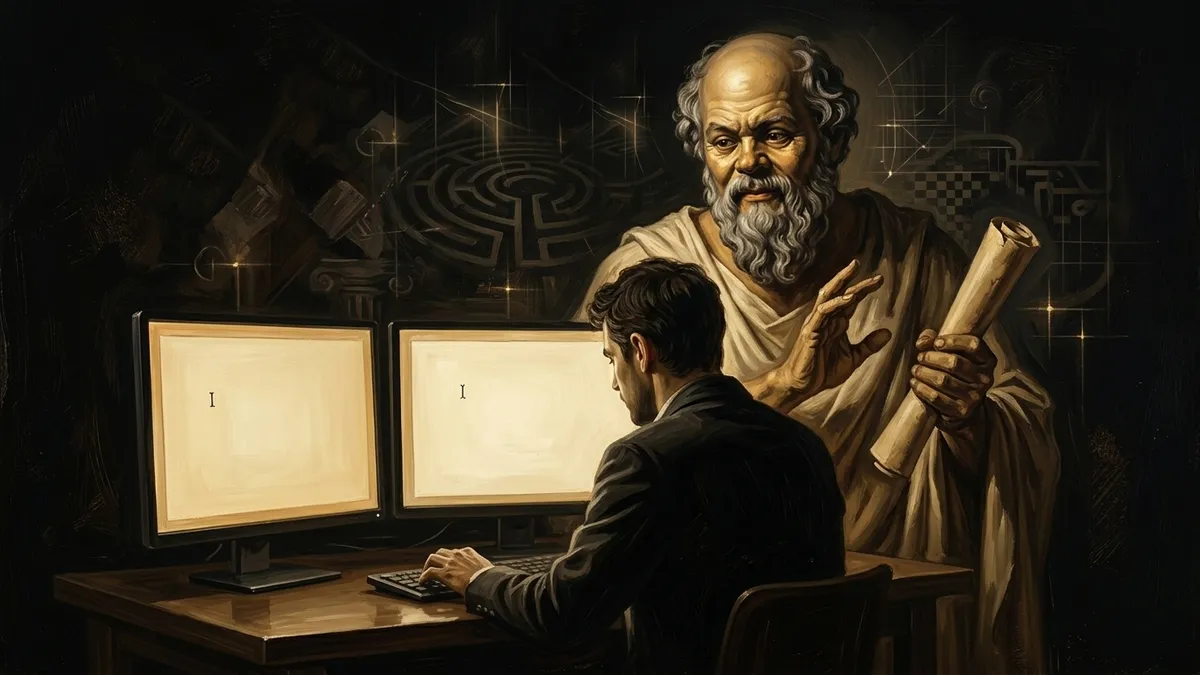
Sophists with Better Suits?
Two windows are open on the desk. In one, a client brief: twenty FAQ questions and answers about a product, structured for citation, schema-marked, formatted so that an LLM can lift any single answer into its own contextless reply somewhere far from this page. In the other, this article. The cursor blinks in both.
You have not started either.
You tell yourself the brief is the problem. The brief is asking for work you don’t like. The client’s underlying copy is weak, the prose is approximate, the value proposition half-formed, but they want to be cited in AI Overviews and they want to show up in ChatGPT, and so the job is to engineer the FAQ that does it. You can do this work. You have done worse. But the cursor blinks.
You switch to the second window. You start typing this article. You feel better. You feel honest. You feel like you are writing for humans, not for machines.
Are you?
Does the shape ever change, or only the acronym?
The client asked for GEO. Before GEO it was AEO. Before AEO it was SEO. The acronyms have been arriving in sequence since the late nineties, each one introduced as the new game and each one carrying the same instruction in different words: write to be parsed, write to be lifted, write to be ranked, write to be quoted in a result page you will never see by a reader who will never know your name. A 2026 brief and a 2014 brief are typographically different and structurally identical. In both cases, you are being asked to produce text whose first reader is not a person.
You know this because you wrote a 2014 brief’s article. Maybe not that exact one, but one like it. You hit the keyword density. You hit the word count. You inserted the H2 every three hundred words. You added the FAQ at the bottom for the featured snippet. You took the money. Did you call yourself a Sophist?
The form is older than the internet, anyway. It is wherever a piece of information has been engineered for a reader who is not the one looking at it.
Think about the last time you wanted a recipe for lasagna. You searched for it. You found a blog post. Before you got to the recipe, you scrolled past eight hundred words about the author’s grandmother, the author’s summer in Bologna, the author’s relationship with pasta as a metaphor for love. You hit “jump to recipe”. You knew, while scrolling, that the eight hundred words existed not for you but for the parser, the ranking signal that rewards depth, the algorithm that decided in 2011 that thin pages were spam. The grandmother in that blog post was not the writer’s grandmother. The grandmother was the algorithm’s grandmother. You were the algorithm’s afterthought.
You did not respect that writer. You did not envy that writer. You envied the income. The income was good. The income was dirty.
Or think about the last time you stood in a kitchen, holding a box of pasta, looking for the cooking time. The cooking time was printed on the box in the smallest type the manufacturer’s lawyers would allow. Not on the front, where you needed it. Not on the back, where you looked. On a side panel near the barcode, two centimeters below the nutritional information. The package was not designed for the cook. The package was designed for the buyer in the supermarket, who had to be persuaded in three seconds at shelf distance. The cooking time was an afterthought because the cook was an afterthought.
The recipe blog, the pasta package, the GEO brief: are they doing the same thing? They are all optimizing for the wrong reader. The right reader is somewhere in the experience, but only just, and only after several centimeters of decoration.
The difference between the recipe blogger who shamelessly piles up the grandmother and the respectable content marketer who carefully crafts thought-leadership pieces is taste, not substance. Both are padding to length. Both are decorating the void. Both are producing parser-shaped artifacts. The recipe blogger just doesn’t bother with the costume. The respectable industry shows up in better-cut suits and pretends that is a different job.
Is it?
Was the reader ever the reader?
Here is the line that gets said at every conference, in every panel, in every writers’ thread on the internet. I write for humans, not for machines.
Notice when the line started. Not in 2024. Not with ChatGPT. It started in the early years of SEO, when the more anxious writers in the industry needed a way to distinguish themselves from the keyword-stuffers. It got louder when content marketing became a profession. It got louder again when listicles took over. Each time the algorithm got more brazen about what it wanted, the writers who served it got louder about how they were not serving it. The defense scaled with the surrender.
But the line has never been true, in the way it claims to be true, of any writer at any point in the history of writing.
The human reader you tell yourself you are writing for is not a person. It is a model in your head. Built from every editor who told you a sentence was too long, every colleague who skipped your email, every comment thread that misread you. It has preferences you anticipate. It has a vocabulary it understands. It has a patience you do not exceed. You optimized for it in every paragraph you ever wrote. You called the optimization “voice”, or “craft”, or “style”, or “knowing your audience”. It was a model running on biological hardware.
The language model in the datacenter is doing the same thing. It just does it explicitly. It does it in numbers you could read if you had access. It does it with a literal-mindedness that strips off the courtesy your imagined reader used to conceal the process.
Did the model introduce the mediation? Or did it just make the mediation visible?
When you say you write for humans and not machines, what are you actually defending? Not the human reader, surely. The human reader was already a model. You are defending the fiction that the reader was not a model. You are defending authorial purity. You are defending the version of your professional self in which writing was a sacred act of expression rather than what it has always been: a long, patient, sometimes desperate negotiation with someone else’s interpretive machinery.
Is this article any different?
Now look at the second window. The one with this article in it.
This article will be eighteen hundred to two thousand words long, because that is what the platform rewards, what the algorithm indexes well, what the reader who finds it on a feed will be willing to spend twelve minutes on. The format was chosen before the first sentence. The TSM voice, the Socratic question form, the slow reveal, the cliff at the end, all of it is a style, and style is a marketing position. The author of this article hates parser-shaped artifacts and is writing one right now. The publication you are reading it in is a parser-shaped artifact. The choice to publish it on a website rather than read it aloud to three friends in a kitchen is itself a parser choice.
Is there an exit? We are inside the thing we are describing. The honest move is not to pretend we are outside. The honest move is to name it. To make the bloat self-conscious. To trust the reader to notice we did not lie about being implicated.
But naming it does not get us out. It just lets us not lie about being in.
Did Plato save Socrates, or betray him?
There is one more layer, and it is the layer that closes the trap.
In the year 370 BCE, in a dialogue called the Phaedrus, Socrates explained why he refused to write. Writing, he said, freezes a thought and separates it from the live exchange. Writing lets the author avoid the questioner. Writing lets the reader take a sentence out of context. Writing is, in his words, a kind of orphan: it cannot defend itself when challenged, cannot answer back, cannot adapt to its reader. The Sophists wrote. The Sophists sold rhetorical optimization for money. The Sophists were the original GEO consultants. Socrates would not be one. He talked. He did not write.
You know about Socrates. You know about his position on writing. You know all of this because Plato wrote it down.
Sit with that for a second.
The Socrates we have, the Socrates we quote, the Socrates whose critique of the Sophists is the foundational Western critique of paid speech-craft, exists only because someone violated the rule he gave us. Plato saved Socrates by betraying him. Every quotation of the Socratic position on writing is, by being quoted in writing, a small treason against the position itself. The Socratic refusal could not survive its own argument.
This article is a written defense of a position whose author would have refused to write it. The reader of this article is consuming, in written form, a critique of writing-for-parsers. The publication you are reading this in is producing parser-shaped artifacts that quote the man who said parser-shaped artifacts kill thought. Is the contradiction a flaw in the argument? Or is it the structure of the argument’s own delivery?
The Sophists won. They won in 370 BCE. They have been winning ever since. The reason the Socratic position is taught at all is that the universities teaching it are themselves Sophist institutions, paid speech-craft sold to paying clients, producing artifacts shaped for citation. Plato founded one of the first. A ranked academy near Athens, optimized for the next generation’s parser. We have been here for two and a half thousand years.
The acronym keeps changing. The shape doesn’t.
Two cursors
Both windows are still open.
You will finish the FAQ for the client. Twenty questions and twenty answers, structured for citation, schema-marked, ready to be lifted into a result page in three months by a model running in a datacenter, quoted to a reader who will never see your name. You will be paid. The client will be happy. The customer will get an answer.
You will also finish this article. Eighteen hundred words, parser-shaped, optimized for the platform, ending in a question that the platform’s recommendation engine will use to decide whether to surface it to the next reader. You will be read, briefly, by some humans, and indexed, permanently, by some machines. Your sentences will be lifted. Your argument will be summarized. The summary will be wrong in the way summaries are wrong. The summary will be quoted somewhere. Maybe in three months. Maybe never.
The cursor blinks in both windows.
You hate this. You hate the recipe blog’s grandmother and the pasta box’s side panel. You hate the GEO brief on your desk. You hate the entire industry pretending to write for humans when the parser was always the customer. You hate that this article, the one you wrote to honor the Socratic position, is itself a Sophist artifact by the rules its own subject set out twenty-four centuries ago.
Then why are you still writing?
If the only honest answer is that you cannot stop, that the act of writing is the only way you know how to think, that you would rather produce parser-shaped artifacts that are at least self-conscious about being parser-shaped than fall silent and let the unselfconscious ones inherit the entire web, then say it. Say it in the article. Don’t pretend it is a defense. It is a confession.
Are the Sophists the enemy? Or are they the medium? We have all been Sophists since the alphabet. Socrates is the patron saint of the people who were too honest to write, and the proof that those people lose. We remember him only because someone less honest took notes.
So when you close this tab, and you go back to your own document, and the cursor blinks at you, ask the question that this article has carefully not answered.
Who is your reader, really?
And what shape are you about to give them?