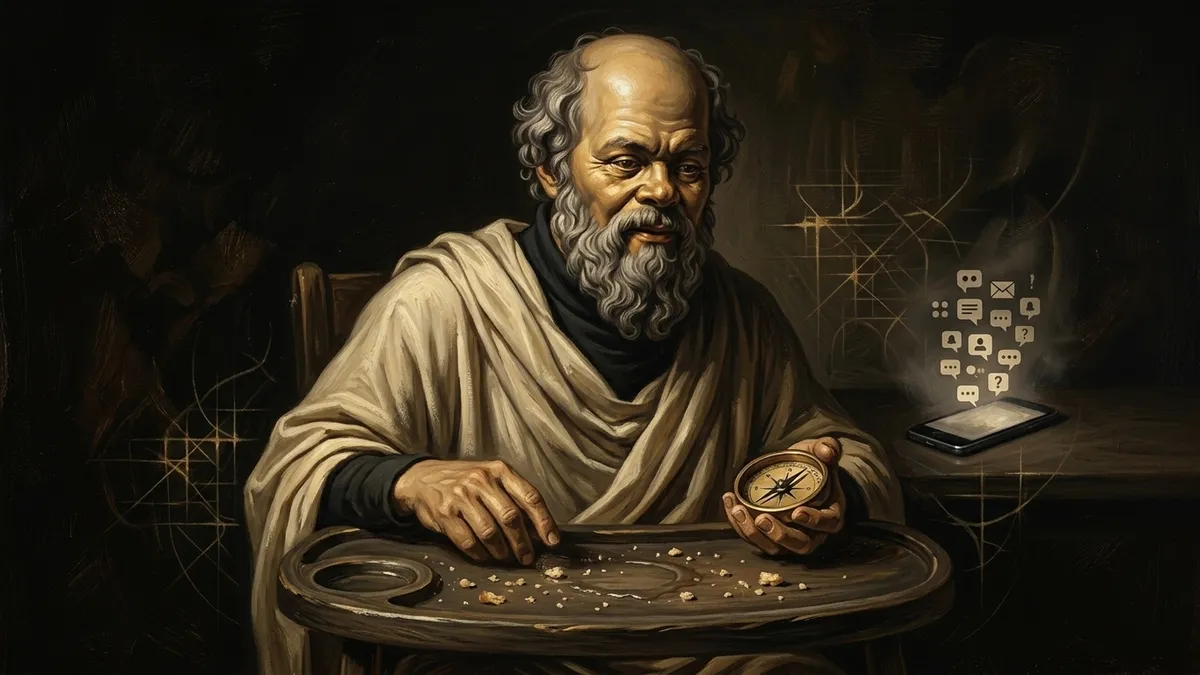
The Bottle You Can't See
My daughter is eight months old. She has opinions about very few things, but the ones she has, she holds with absolute conviction. The water bottle is one of them.
During dinner a few nights ago, she was eating. At some point, she stopped, looked at the bottle, and pointed. She wanted to drink. We gave it to her. She drank. And then, because she’s eight months old and everything is a toy, she started playing with it. Tapping it on the highchair. Shaking it. Examining it like a scientist with a new artifact.
When she finally set it down, I saw my window. I reached over and slid the bottle out of sight.
She noticed immediately. The lamenting started. Not crying, exactly… that particular sound babies make when the universe has wronged them and everyone needs to know.
So I gave it back. She brought it to her lips, took a sip that was barely a sip… more performance than thirst… and went right back to playing with it. She didn’t want water. She wanted the bottle in her world, visible, touchable, hers.
Then her mother offered her a spoonful of something interesting. My daughter’s attention shifted to the food. And in that gap, unnoticed, I slid the bottle behind my back.
Nothing happened.
No lamenting. No searching. She ate. She babbled. She was fully, completely present with whatever was in front of her. The bottle didn’t exist. Not “she accepted it was gone.” Not “she moved on.” It simply wasn’t part of her world anymore. The craving vanished as cleanly as if it had never been there.
When dinner was over and she was lifted from the highchair, she started looking around. Not frantically. Just… searching. Something was missing but she couldn’t quite assemble what. I pulled the bottle out. She smiled, drank properly this time, and set it aside. No playing. Whatever loop had been running earlier was closed now.
I sat there watching her and thought: that’s not a baby thing. Is it?
How many graveyards are on your phone?
How many todo apps have you downloaded? Not the ones you use. The ones you used. The ones where, right now, there are seventeen items you once thought were important enough to type out, organize, maybe even assign a due date to. Items still sitting there, unchecked, in an app you haven’t opened in four months.
Were those things not important?
Some weren’t. But some were. Some were conversations you needed to have. Projects that excited you at 2am on a Tuesday. Ideas that felt like they could change the trajectory of your work, maybe your life. So what happened? Did you decide they didn’t matter? Did you weigh your options and choose to move on?
Or did the list itself drift out of your sight… and when the list disappeared, everything on it disappeared with it? Not deleted. Not decided against. Just gone. The same way the bottle stopped existing for my daughter the moment it slid behind my back.
You might think the solution is a better app. A better system. Something with reminders, notifications, recurring nudges. Something that forces things to stay visible.
But when was the last time you actually read a notification from your todo app?
Do you still hear the ping?
Think about what happens. You install the app. You enable notifications. For the first week, every ping feels like a tap on the shoulder: “Hey, remember this thing you care about?” You act on it. You check things off. You feel productive, intentional, in control.
What about week three? Are the pings still taps on the shoulder, or have they become furniture? Did you consciously decide to start ignoring them? Or did something more efficient happen… something you didn’t choose and didn’t notice?
Your brain reclassified them. Signal became noise. The notification still fires. Your eyes still see it. But do you?
Isn’t this the same brain that helped my daughter forget the bottle? Not broken. Optimizing. An extraordinary machine for one specific task: spending attention only on what’s in front of you, right now, demanding action. Everything else gets quietly archived. Not deleted… archived. In a cabinet you’ll never open again.
So what happens when the tool you built to keep things visible becomes another thing that fades into the background? And then the tool that reminds you about the tool? And then the weekly review that was supposed to catch everything the tools missed? Layer after layer of systems designed to fight forgetting, each one eventually swallowed by the very thing it was designed to prevent.
Is that a productivity problem? Or is it something deeper?
Who remembers what was said in the retro?
Think about your last team retrospective. Someone raised a concern. Something real. Maybe it was about an architectural shortcut that would cost you later. Maybe it was about a process that was quietly burning people out. Everyone nodded. Someone said “we should address that.” Maybe it even made it onto a board somewhere, a sticky note in a digital column.
Where is it now?
Not the sticky note. The concern. The thing that was true enough for someone to say it out loud in a room full of colleagues. Is it resolved? Or did it migrate from the board to the backlog, from the backlog to the “later” column, from “later” to that grey zone where things exist technically but not practically? Where they have a Jira ticket but no heartbeat?
How many optimization conversations have your teams had about systems that are still unoptimized? Not because someone decided the optimization wasn’t worth it. Not because anyone weighed the cost and said “no.” But because the conversation ended, the sprint moved on, and the thing that was visible for forty-five minutes in a meeting room went back to being invisible?
If your retrospective board is your daughter’s dinner table, and the concerns are the water bottle… how many sprints has it been since anyone cried for them? Does anyone even remember they were there?
When did you stop working on the thing that mattered?
You had a side project. Maybe you still think you have one. That thing you were going to build. The language you were going to learn. The project that kept you up late with the particular kind of excitement that feels like purpose.
When was the last time you worked on it? Not “thought about it.” Not “felt guilty about it.” Actually opened the repo, the document, the notebook. Actually did the thing.
If the answer is weeks, months… here’s the question that matters: did you decide to stop? Was there a moment where you weighed your priorities and consciously chose that this thing no longer mattered?
Or did a busy week push it to “tomorrow”? And tomorrow became next week? And next week became “when things calm down”? And things never calmed down? And at some point the project left your line of sight and your brain, that brilliant optimizer, did what it does?
You didn’t abandon the project. You didn’t kill it. Can you abandon something you’ve stopped seeing? Can you kill something that, as far as your brain is concerned, no longer exists?
My daughter doesn’t miss the bottle she can’t see. Do you miss the project you’ve forgotten?
What if you’re not bad at remembering?
We talk about forgetting like it’s a failure. A weakness. “I should have followed up.” “I need a better system.” “I need to be more disciplined.” As if the problem is insufficient effort and the solution is a better calendar.
But what if forgetting is not the failure mode? What if it’s the operating mode?
Your brain processes an obscene amount of information every second. It can’t hold everything. Should it? A brain that remembered everything with equal intensity… would that be a better brain, or a broken one? Isn’t the ability to let things fade exactly what allows you to focus on what’s in front of you?
It’s the same optimization that lets my daughter be fully present with her food after the bottle disappears. She’s not suppressing desire. She’s not practicing mindfulness. Her brain is doing exactly what brains do: attending to what’s visible, releasing what’s not.
So if the optimization is working as designed… what is it costing you?
Can you fight a feature with a patch?
Every productivity system, every notification framework, every “second brain” app is built on the same premise: the brain forgets, so we need external systems to remember for us. An entire industry exists because of the bottle problem.
And these systems work. For a while. They keep things visible. Until they become another layer of noise. Until the system itself needs a system. Until you have a todo app to remind you to check your todo app, a weekly review to remind you to do your weekly review, and a yearly reflection to remind you that you stopped doing your weekly reviews in March.
The billion-dollar attention economy understands your daughter’s brain perfectly. Every notification badge, every unread count, every “you left something in your cart” email is engineered to keep the bottle on the table. They know that desire requires visibility. They know that the moment something leaves your awareness, the craving dies.
But even they can’t solve it. Push notifications? You mute them. Email nudges? They go to a folder you don’t check. App badges? Your eyes learned to skip them. If the most sophisticated visibility machines in human history eventually get optimized away by the same brain they’re trying to hack… what chance does your calendar reminder have?
The carrying capacity of attention is finite. And everything that exceeds it doesn’t get rejected. It doesn’t get a decision. It gets something worse. It gets silently forgotten. No funeral. Just absence.
Hold that word. Absence.
The question you can’t answer
When dinner ended and my daughter was lifted from her highchair, she looked around. Something was missing. She couldn’t name it, couldn’t point to where it should be. Just a vague sense of absence, a searching without knowing what she was searching for. I pulled the bottle out. She smiled. She drank. The loop closed.
She was lucky. Someone was holding the thing she’d forgotten, ready to give it back.
Who’s holding yours?
How many times has your brain done this to you? Not with water bottles. With things that mattered. A friendship that faded not from conflict but from absence. A creative impulse that visited you for a season and then left without you noticing it had gone. A version of yourself you were building toward, slowly, until life got loud and that version slipped out of sight and your brain, that efficient, ruthless optimizer, cleaned up the craving as if it had never existed.
Can you make a list of these things? Can you audit what you’ve forgotten? Can you mourn what you don’t remember wanting?
Right now, there is something you used to care about deeply. Something that, for a while, felt like it mattered more than most things. You don’t know what it is. Not because you decided to let it go. Because it left your sight long enough that your brain did what brains do. It’s gone. You won’t think about it again.
Your daughter looked around at the end of dinner, and someone pulled the bottle out for her. She smiled.
But who’s holding the things you’ve forgotten? Who will pull them out and show them to you?
When you look around, sometimes, with that vague feeling that something is missing… what if something is? What if something always was?
And what if you’ll never know what it was?