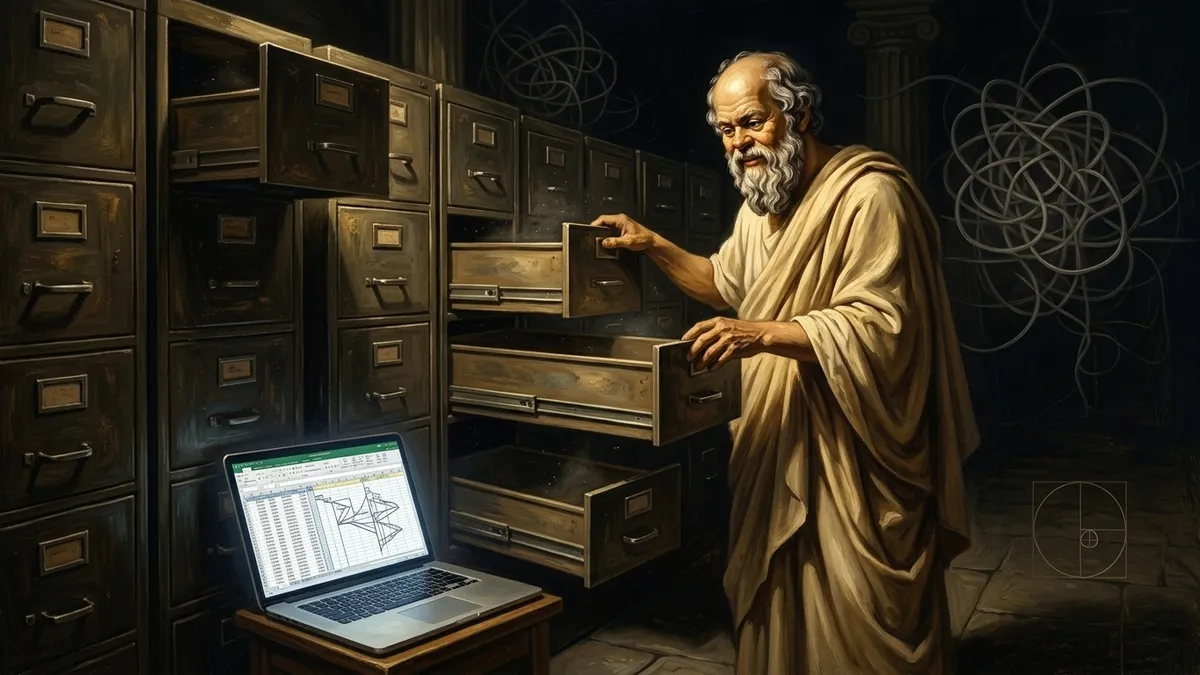
Where Do Our Decisions Rest?
There is a file.
You know the one. Maybe it lives on a shared drive. More likely it lives on one laptop and travels by email under a name like Forecast_2026_FINAL_v7_USE_THIS_ONE.xlsx. It has forty tabs. Three of them are colored red and nobody remembers why. It holds numbers the ERP does not have, because, as everyone agrees with a small apologetic smile, “we put in the Excel file what can’t go in the ERP.”
The company paid six figures for the ERP. The company runs on the spreadsheet.
When you ask about it, someone shrugs. It’s just a spreadsheet.
I want to sit with that sentence, because I think it is one of the more dishonest things we say in our working lives, and we say it constantly, and we say it about the things that matter most. Hold on to it. We’ll come back to what the word just is doing.
I have watched this file run companies. Not help run. Run. A company I gave real years to was held together by Excel files of genuinely poor design, and while that was not the single reason it failed, it was the texture of how an organization thinks when its source of truth is a workbook one person understands. And it was not unusual. It was typical. Every company I have worked with since has had its version of the file. The file that contains the truth. A wrong truth, often, but the one everyone acts on, the one taken more seriously than any system that cost a hundred times more to install.
Ask why the real number lives in the spreadsheet and not the system of record, and you will get a reasonable answer about flexibility, about how the business “doesn’t fit” the ERP, about how this was faster. All true. But notice the sentence that closes the conversation every time: it’s just a spreadsheet. Don’t worry about it.
So here is the question that sentence exists to prevent. If it runs the company, in what sense is it just anything?
What did it never have to pass?
Think about everything a real system has to clear before it gets near production. Design review. An owner of record. Documentation. Tests. Redundancy. On-call. A succession plan for when the person who built it leaves. We have whole disciplines, change-advisory boards and architecture guilds, built for one purpose: making sure no critical thing depends on one person’s undocumented decisions.
The most critical thing in the building sailed past all of it. Did it earn the exemption, or did it just receive one?
Could it be that the word just was the exemption form? That calling it a spreadsheet was the precise move that let it skip the line every real system has to stand in?
I have seen the purest version of this. An employee, long gone now, who built a set of password-protected workbooks for “doing the thing,” whatever the thing was for that company. Pricing, maybe, or a reconciliation nobody else understood. The macros worked. The outputs were trusted. Then the person left, and took the password with them, and the file could not be opened and could not be abandoned, because no software on earth replaced it, and, more to the point, replacing it did not mean buying a tool. It meant changing how the company did the thing. The file was not storing the process. The file was the process. Undocumented, unowned, password-protected by a ghost, and still running, quarter after quarter, long after its author stopped being reachable.
When was the meeting where someone decided to bet the company on that file? Who stood up and proposed, out loud, that the most important process in the building should depend entirely on one person’s private macros, with no backup and no documentation? If anyone had said it that plainly, would it have survived the room?
The bet got placed anyway. One “it’s just a spreadsheet” at a time. Each one too small to object to. Each one setting down a little more responsibility into a file that was, you understand, just a tool.
Different tool, same shape
The Jira board the team grooms more carefully than it ships. The Slack that was going to make us faster, and instead made every decision provisional, re-litigable, scrollable, never quite closed. The PowerPoint three people spend a full day building every Thursday for a meeting in which nobody reads past slide four. Ask about any of them and the shrug is the same. It’s just a tool. It’s just where we coordinate. It’s just a deck.
So every time, is the word describing the size of the thing? Or is it excusing us from looking at what the thing has become?
Stay on Jira for a minute, because it is the cleanest case. Somewhere along the way the describing of the work became a discipline of its own. Epics, story points, grooming, refinement, velocity, the burndown. There are people whose week is mostly the board. The ritual of accounting for the work grew until it was, measured in hours, more real than the work it accounts for. And the whole apparatus sits comfortably on three words. It’s just where we track things.
Then someone finds Linear. And Linear is genuinely lovely: fast, quiet, opinionated, fewer knobs by design. The pitch writes itself. Jira is bloat, this is focus. A migration gets proposed, and the migration is sold not as a new tool but as a new way of working.
Watch what it costs and what it buys. A quarter of cycles. Re-tagging a thousand tickets. Exports that do not map. The arguments that begin “well, in the old tool we did it this way.” And when the dust settles, the standup runs the same length, the same decisions get re-litigated in the same channels, the same work does not ship any faster. The board is prettier. The shortcuts are better. What, precisely, changed?
If we can lift the work out of one tool and set it down in another, and the work itself does not move, was the tool ever the variable? Or were we the variable all along, and the tool only ever the thing we could point at instead?
And it is not only the trackers. There is the wiki, the Confluence or the Notion everyone was told to keep current, now a sediment of pages last touched by people who have since left, where the answer to the question we are asking sits on some page the search will not surface. There is the Slack thread where a decision was genuinely made, real arguments, real consensus, a clear yes, now scrolled so far into the dark that next quarter the same decision gets made again, from scratch, by people who never learned it was already settled. Same shape every time: a tool filling up with the memory of how we decided things, while the people who could still read it leave, one resignation at a time.
So it was never the size of the thing. The question underneath all of them is the one we keep arriving at from every direction: who owns what the tool remembers, and can they still read it?
What if we ran on nothing?
Here is the escape that suggests itself. If the tool is not the variable, why carry one at all? Picture the team that runs on nothing. No board, no tickets. Decisions in people’s heads, on a whiteboard wiped each Friday, in the easy “yeah, we agreed on that.” For a while it feels like freedom. Less ceremony. More building.
Then count past a dozen people. Where does the thing everyone is supposed to remember actually live? In a dozen heads that have each quietly started to remember it differently. In a decision no one can locate, because it was settled in a hallway. In the one person who can onboard the new hire, because the whole of it is in their head and nowhere else. And that person, the week they hand in their notice?
We have met them already. We opened with their spreadsheet. Running on nothing does not delete the memory. It moves the memory back inside a single human, undocumented, unowned, and unreadable the morning they leave. There is not even a file to inherit this time. There is not even a password to lose.
So the work needs somewhere to keep its memory. That part was never optional, and it was never the question. The question was always whose memory, in what form, and who can still open it once the author is gone.
That is the same question we have been asking about the spreadsheet since the first paragraph. And it is about to follow us somewhere less comfortable than a project board.
Sure it’s them we’re nodding at?
We have read this far picturing someone. That company. That ghost with the password. Some finance team that does not know what a system is.
Let me turn the lamp around. What did we say this week?
That the model finishing our code is just autocomplete? That the agent we let into the repo is just a tool, and we review everything it does? And do we, every time? Or did the accepting start the way that company started trusting the spreadsheet, a little at a time, each acceptance too small to object to?
Here is the question I cannot put down, and I will hand it to you exactly as it arrives at me. The spreadsheet, for all its sins, at least sat somewhere. We could point to it. It had a filename. It lived on a drive. We knew where the company’s real decisions were kept, even if we could not open them.
Where do our decisions rest?
In a ChatGPT history we will never re-read? In a MEMORY.md file some agent has been quietly editing on our behalf, recording what we “decided” in a voice that sounds like ours? In an esoteric folder belonging to a skill we did not write, that arrived with a plugin, that now shapes how the work gets done in a directory we own? In whatever store Codex or Claude or the next one uses to keep its sense of what we want?
Those are just tools. And they now hold our decisions. They remember why we chose things after we have forgotten. They carry the context forward into work we have not done yet.
So if the record of why we decided something lives in a tool we did not build, in a format we cannot read, maintained by a process we do not control, is it still our decision? Or have we done to our own judgment exactly what that company did to its forecast, moved the truth into a thing we call just a tool, and stopped being the ones who can open it?
The file with no door
The spreadsheet took years to become the thing the company could not live without and could not explain. It had to be built, tab by tab, by a person. What does the new dependency need? Not a person. It assembles itself, out of our habits, in stores we never see, and it does not even leave us a file to inherit. There is no password to lose, because there was never a lock, because there was never a door, because it never lived anywhere we could walk up to and point.
So go find the file. The spreadsheet, the board, the deck, the chat, the model, the memory none of us quite wrote. The thing the work cannot proceed without, that nobody decided to trust, that no one owns, that we would all defend, if anyone pushed, with the same small apologetic smile and the same three words.
Did we call it just a tool because it was small?
Or so that no one would ever have to be the one who owns it?
Whose decision was that?